Moray Eel
Reef's Crevice Predator
Gymnothorax javanicus (Giant Moray)
Meet the ocean's crevice predator—serpentine hunters reaching 2 meters whose pharyngeal jaw systems shoot forward from throats generating up to 150-Newton force. Their elongated bodies navigate the narrowest reef spaces enabling unique hunting advantages. Cooperative partnerships with groupers and enhanced chemoreception create sophisticated ambush predation in complete darkness.
Discover the Crevice HunterWhat Makes Them Special
Pharyngeal Jaws
Secondary jaw system shoots forward from throat generating up to 150-Newton force capturing prey instantly
Serpentine Design
Elongated 2-meter bodies with reduced fins navigate through spaces wider than body diameter effortlessly
Cooperative Hunters
Partner with groupers using head-shaking signals increasing documented hunting success through coordinated ambush tactics
Chemical Navigation
Enhanced chemoreception compensates for vision enabling prey detection through chemical trails in complete darkness
Powerful Grip
Backward-curved teeth and dual-jaw system prevent prey escape in confined crevice spaces
Crevice Specialists
Exclusively adapted for confined hunting accessing prey unavailable to other predators through specialized anatomy
First Encounter
2-Meter Serpentine Predators with 30-Kilogram Mass
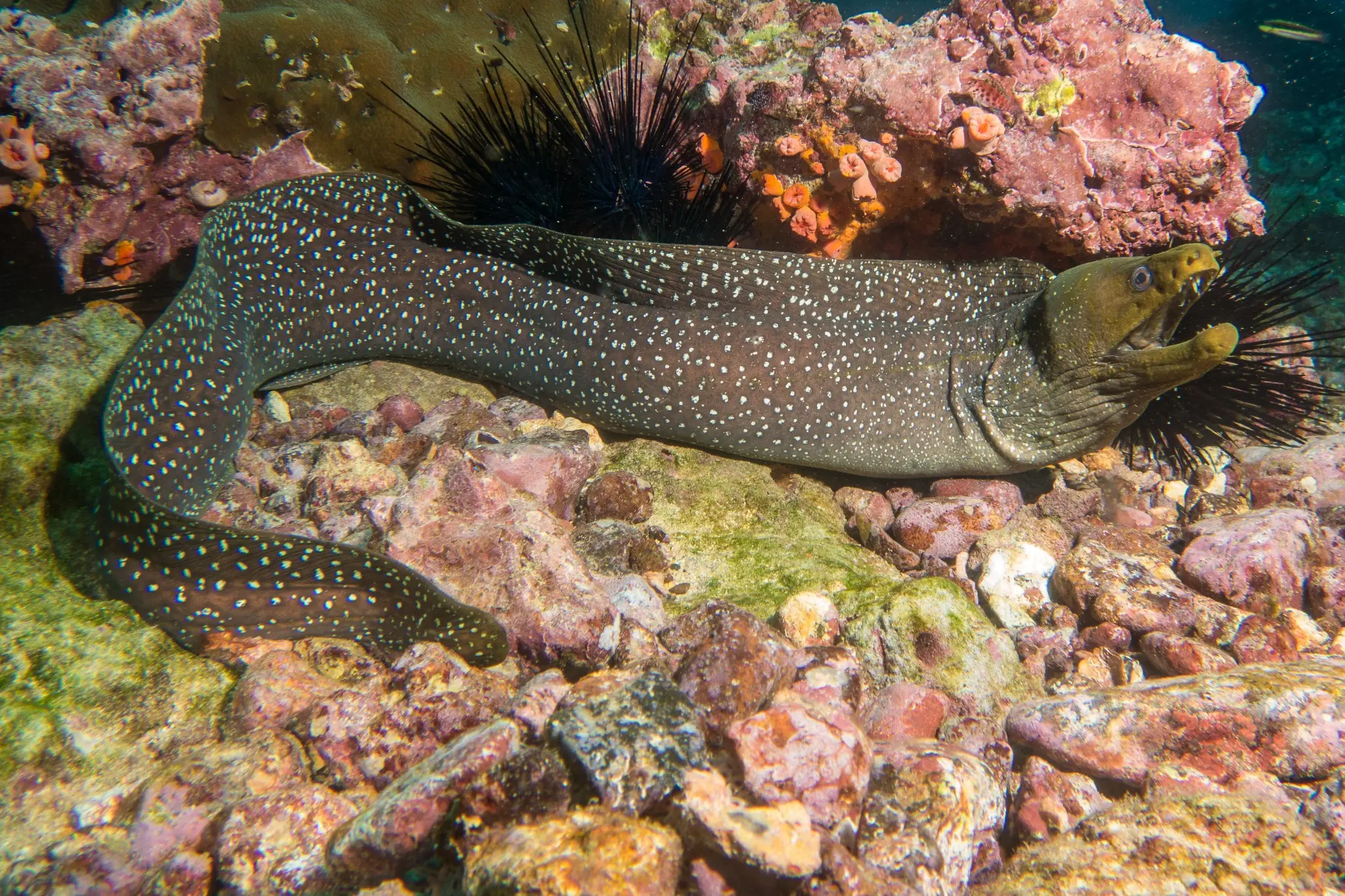
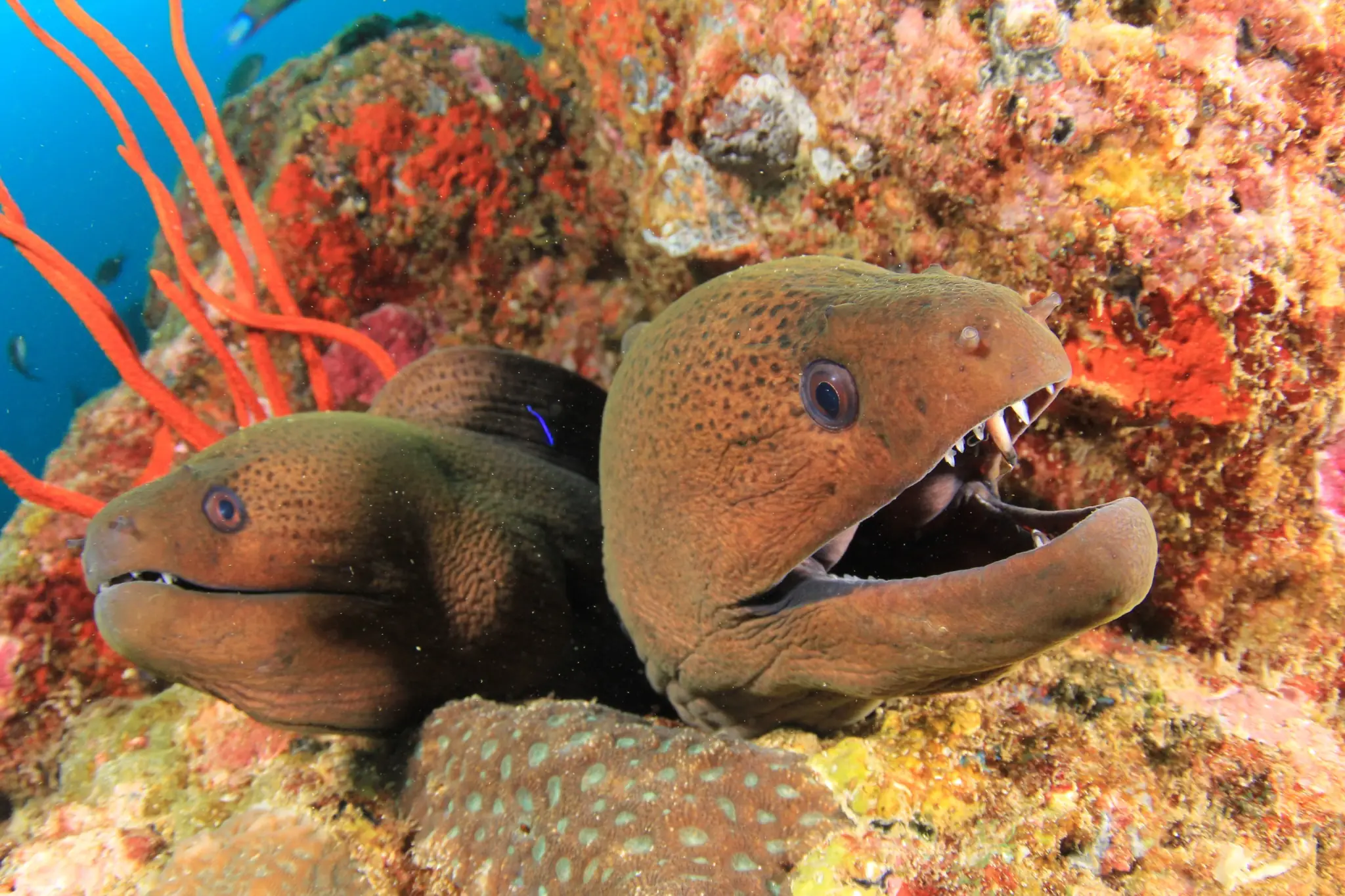
Giant moray eels reach 2 meters and 30 kilograms navigating narrowest reef spaces with muscular undulating movements. Mottled brown patterns provide camouflage against coral while powerful jaws lined with backward-curved teeth create intimidating expressions concealing sophisticated predatory adaptations.
These serpentine forms master confined space hunting equipped with unique double-jaw systems evolved for crevice ambush tactics. Some species produce toxic mucous providing additional defense. Their menacing appearance masks remarkable biomechanical engineering enabling access to hidden prey through spaces no other large predator navigates. Photo: HakBak.
"Moray eels possess the most extreme pharyngeal jaw system among vertebrates—a second set of jaws that shoots forward to capture prey, extending 2 centimeters beyond their oral jaws with remarkable ballistic precision."
— Dr. Rita Mehta, Functional Morphology Research
Pharyngeal Jaw System
Revolutionary Secondary Capture Mechanism
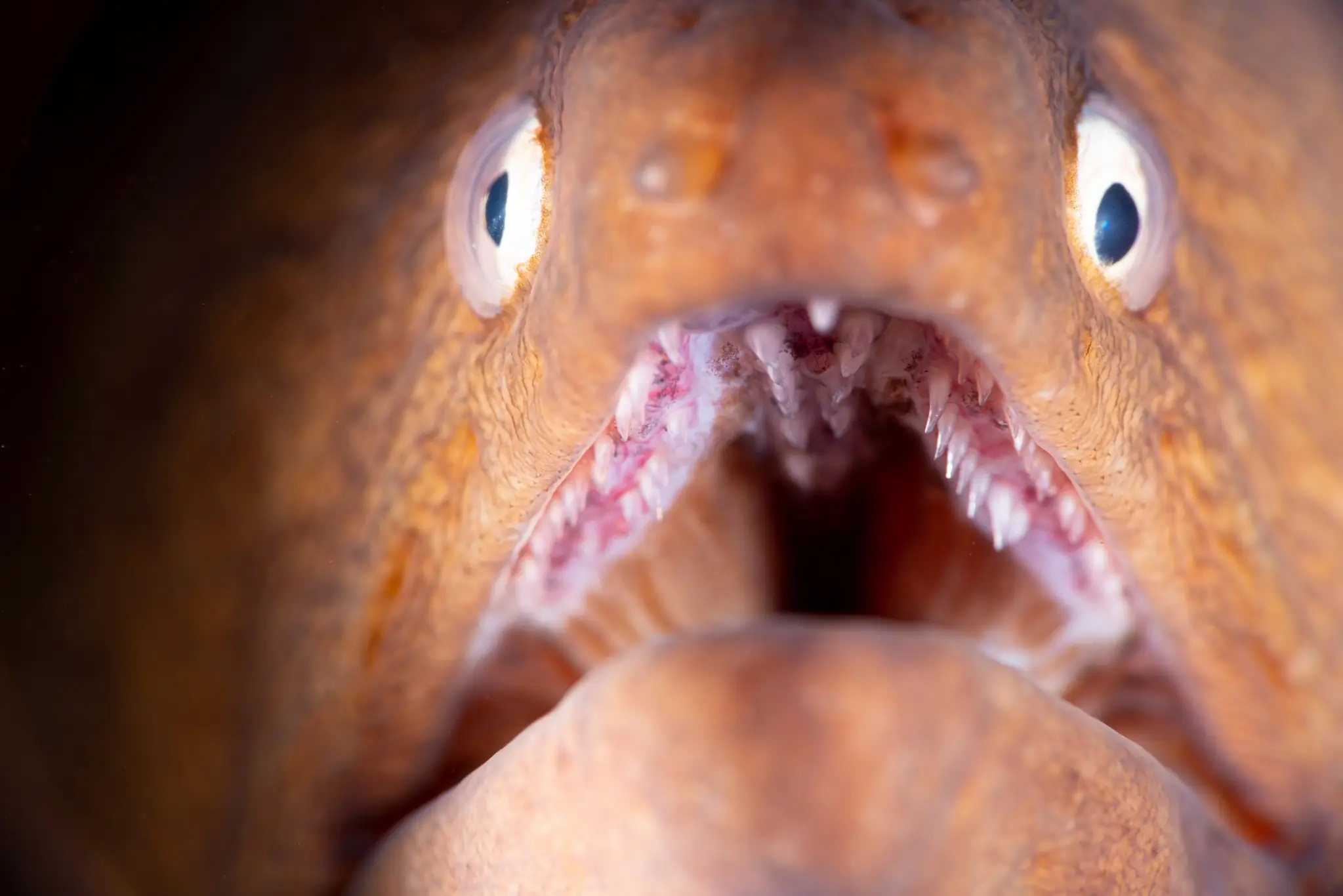
Unique pharyngeal jaws equipped with backward-curved teeth shoot forward from throat to grasp prey captured by oral jaws. This ballistic jaw projection ensures secure capture operating with forces exceeding 150 Newtons.
Pharyngeal jaw extension occurs in 0.1 seconds pulling captured prey deeper into esophagus while oral jaws maintain external grip. This secondary capture system eliminates suction feeding needs in confined crevice environments where water displacement creates feeding challenges. Photo: Samy Kassem
Elongated Body Design
Serpentine Architecture for Tight Spaces
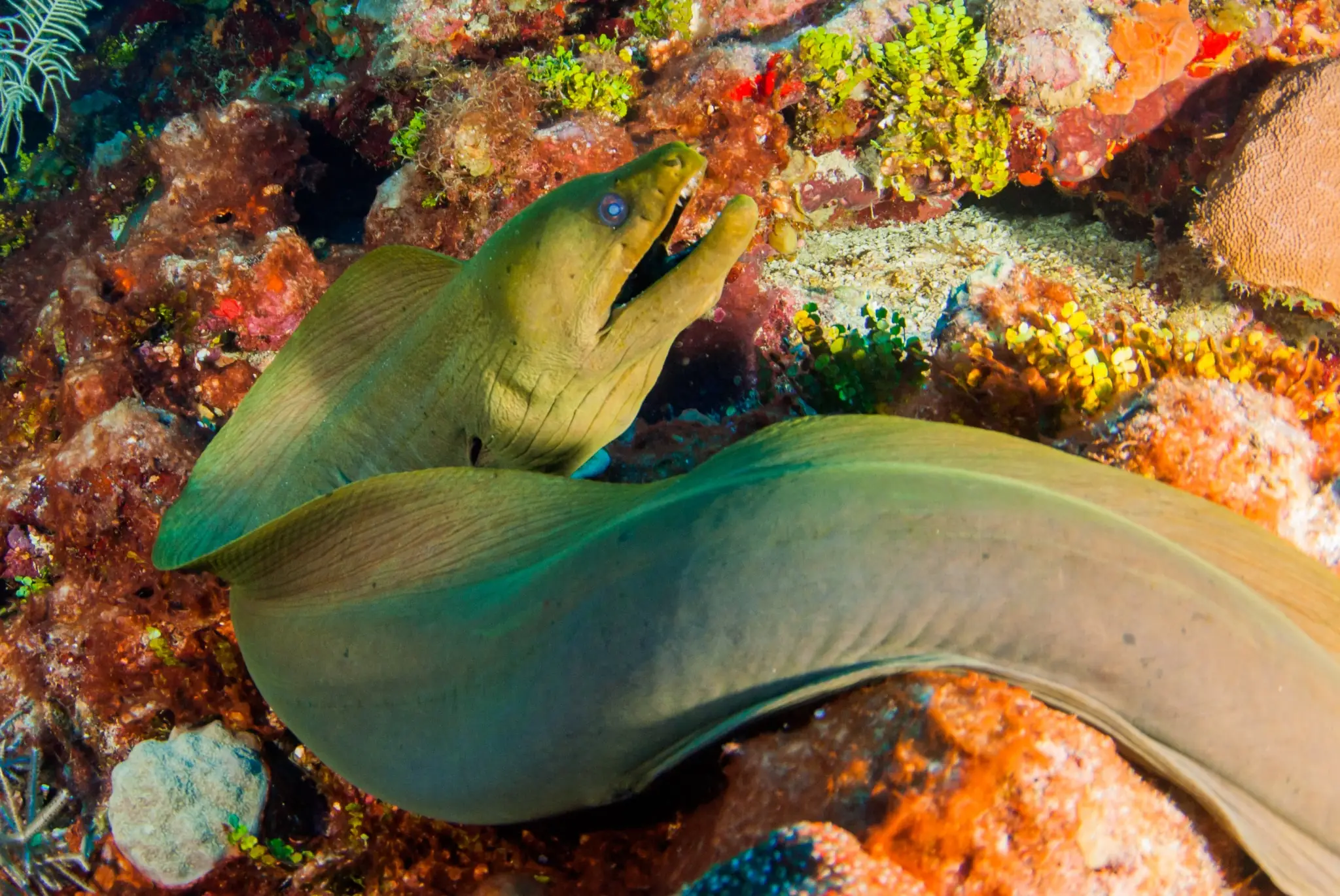
Serpentine body shape with dramatically reduced pectoral and pelvic fins enables navigation through spaces wider than body diameter. Continuous dorsal and anal fins extending along entire body provide propulsion in confined quarters where tail-based swimming proves ineffective.
Muscular body wall generates powerful undulating locomotion while thick mucus-covered skin provides protection against abrasive coral surfaces. This specialized cylindrical design enables access to hidden prey refuges unavailable to other reef predators creating unique ecological advantages. Photo: Drew McArthur.
"Cooperative behavior studies reveal moray eels and groupers coordinate hunting using specific signals—the only documented interspecific partnership where fish communicate across taxonomic families to increase predatory success."
— Dr. Redouan Bshary, Interspecific Cooperation Research
Cooperative Hunting
Interspecific Partnership with Groupers
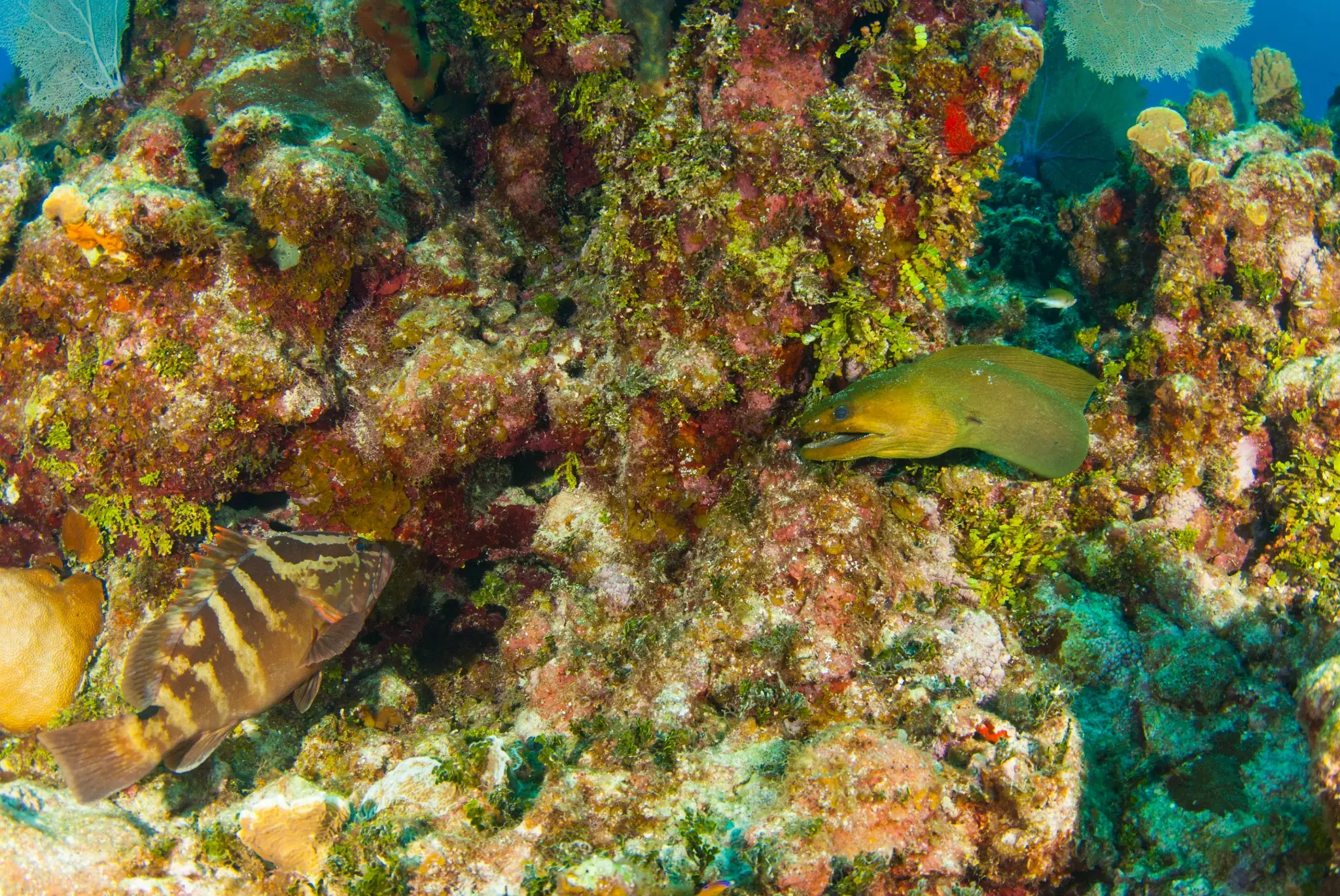
Moray eels form hunting partnerships with groupers and reef predators through head-shaking signals and coordinated movements. Morays flush prey from crevices where groupers cannot access while partners capture escapees in open water creating complementary hunting strategies.
Communication involves specific body language and precise timing coordination. Research documents these partnerships demonstrate sophisticated interspecies collaboration unique among fish requiring recognition of hunting partners and mutual benefit comprehension across different predatory strategies. Photo: Drew McArthur.
Chemical Navigation
Enhanced Chemoreception for Darkness Hunting
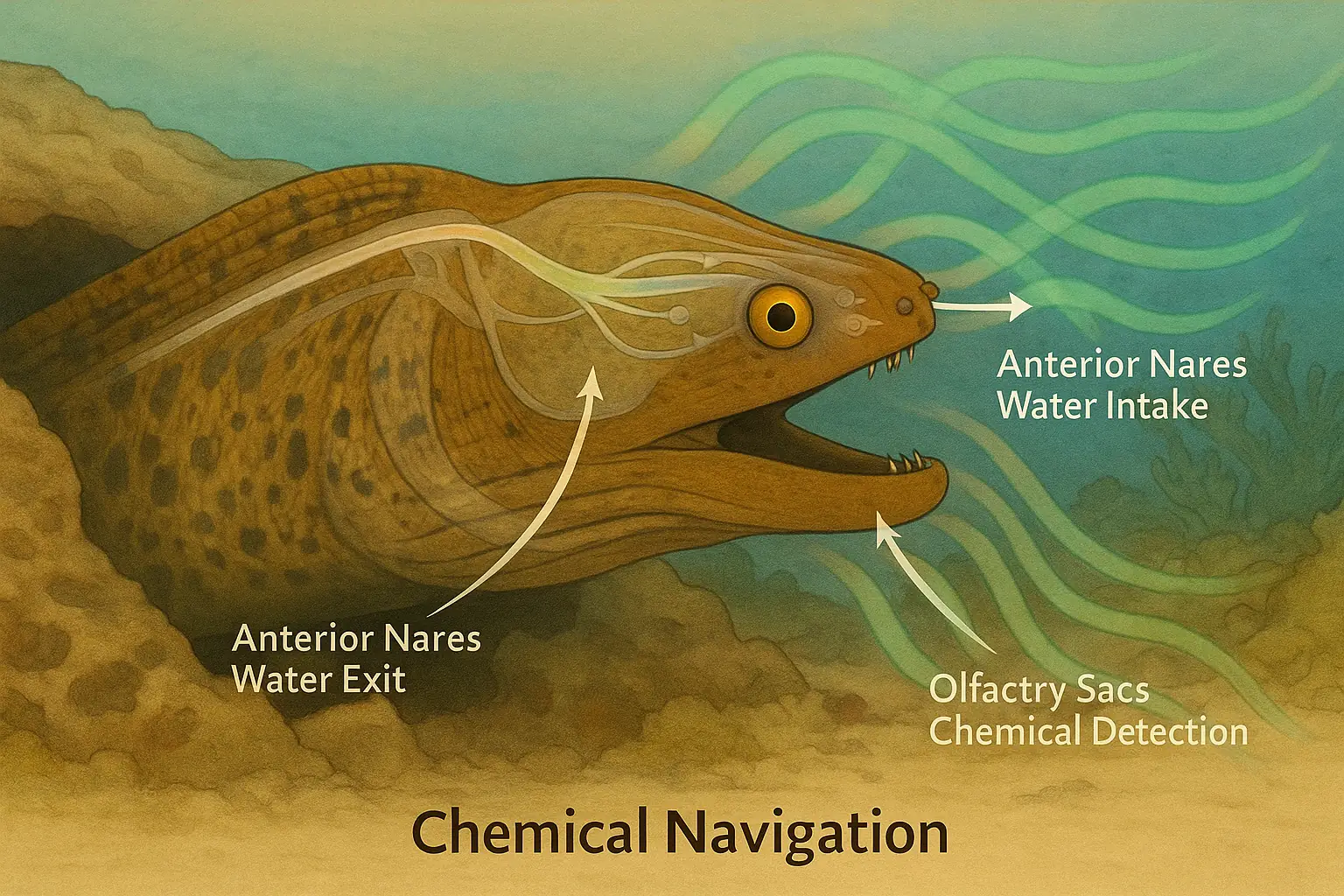
Eyes adapted for low-light conditions are supplemented by highly sensitive chemoreception enabling prey detection through dissolved chemical trails. Specialized olfactory organs in nasal cavity process waterborne compounds detecting prey hidden within reef crevices through molecular signatures alone.
Constant mouth opening and closing pumps water across chemoreceptors while tubular nostrils sample chemical gradients. This sophisticated sensory system enables hunting in complete darkness and detection of hidden prey within complex three-dimensional reef structures giving morays nocturnal hunting advantages. Photo: Illustration.
Conservation Status
Habitat Protection Ensures Stable Populations
Most moray species maintain stable populations though several face pressure from habitat degradation and aquarium trade collection. Their secretive nature and nocturnal behavior make population assessment challenging requiring innovative monitoring approaches through underwater photography and environmental DNA sampling.
Coral Triangle marine protected areas report stable moray populations following crevice habitat restoration and fishing gear restrictions. Cooperative hunting research guides reef ecosystem management by recognizing critical interspecific predator relationships protecting both morays and grouper partners. Photo: Rich Carey.
Science & Discovery
University of California recent biomechanical research revealed pharyngeal jaw muscles generate 40% greater forces than previously measured inspiring dual-gripper robotic systems for confined space manipulation in underwater salvage and exploration technologies.
Max Planck Institute 2023 behavioral studies documented moray-grouper partnerships involve complex decision-making where morays assess grouper hunting ability before accepting partnerships demonstrating social cognition previously unknown in solitary predatory fish.
Marine Biological Laboratory recent genomic analysis identified olfactory receptor gene expansions in moray lineages explaining exceptional chemoreception capabilities and guiding development of underwater chemical detection sensors for environmental monitoring
In our delightful oceans, moray eels generate up to 150-Newton pharyngeal jaw forces enabling unique crevice predation. Cooperative grouper partnerships demonstrate sophisticated interspecies communication. Coral Triangle marine protected areas report stable populations following habitat restoration and fishing gear restrictions.