Chambered Nautilus
The Living Submarine
Nautilus pompilius
Meet Earth's last shelled cephalopod—the chambered nautilus, a 20-centimeter (8-inch) drifter patrolling reef slopes 100-700 meters (330-2,300 feet) down, sole survivor of a lineage 500 million years old. Some 30 gas-filled chambers work as a living submarine, tuned by a tissue tube threading through them. Its pinhole eyes have no lens at all.
Descend the Reef SlopeWhat Makes Them Special
Living Submarine
Some 30 gas-filled chambers give precise buoyancy control, adjusted through a tissue tube
Pinhole Eyes
Eyes work like a pinhole camera, with no lens and blurry vision
Ninety Tentacles
Around 90 grooved tentacles without suckers grip prey and taste the water
Depth Limit
Live between 100 and 700 meters (330-2,300 feet); below 800 meters the shell implodes
Slow Life
Take about 15 years to mature and can live beyond 20
Shell Trade
Hunted for ornamental shells, now regulated worldwide under CITES Appendix II since 2016
First Encounter
A Shell From Deep Time
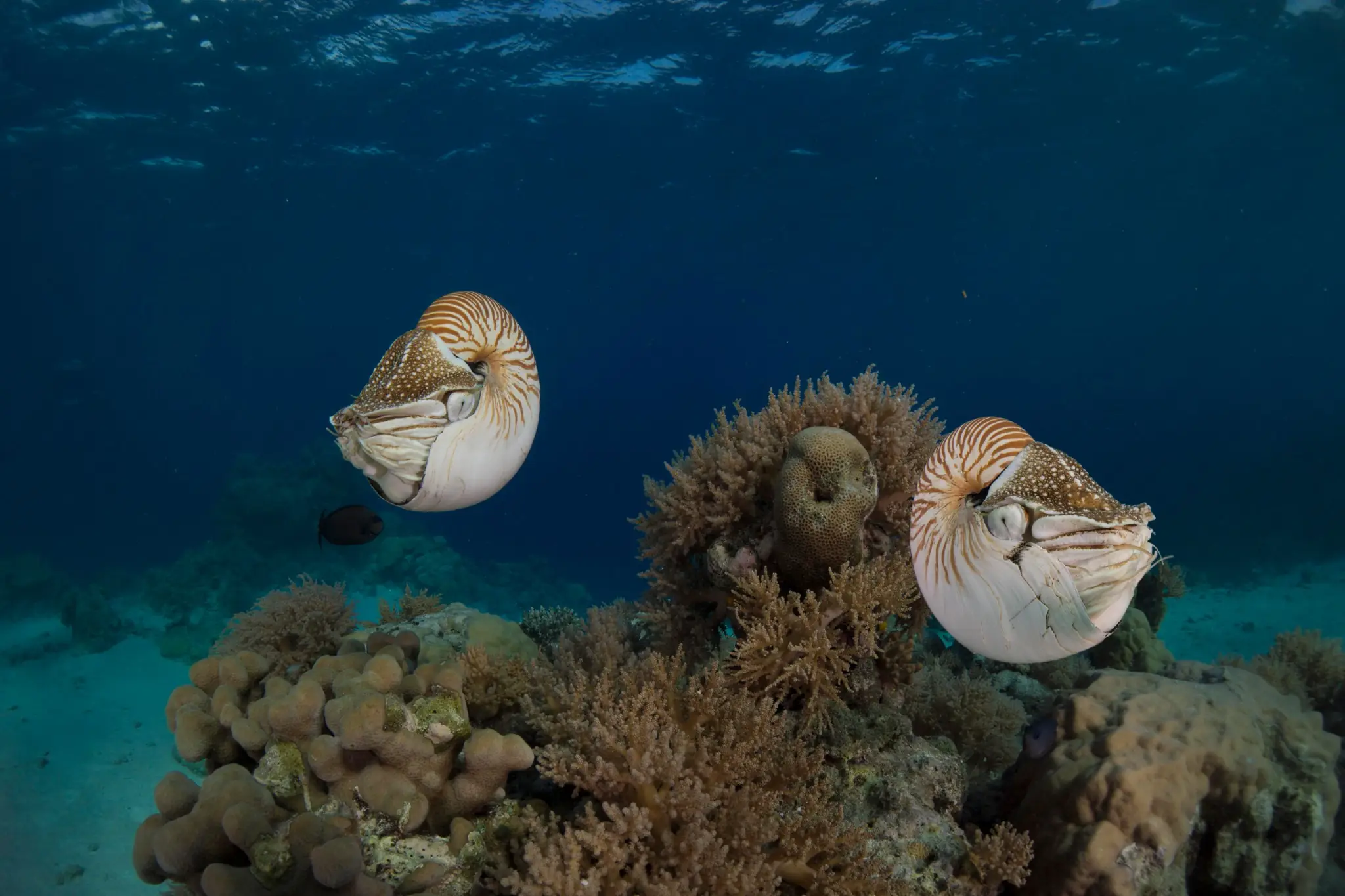
A perfect spiral drifts out of the dark—cream and brown flame stripes across a shell 20 centimeters (8 inches) wide, with a leathery hood and a crown of pale tentacles.
The stripes are countershading—dark above to vanish against the depths, pale below to blend with sunlight from above. Inside, lustrous nacre lines every sealed chamber in shimmering layers of mother-of-pearl. Photo: Alex Permiakov
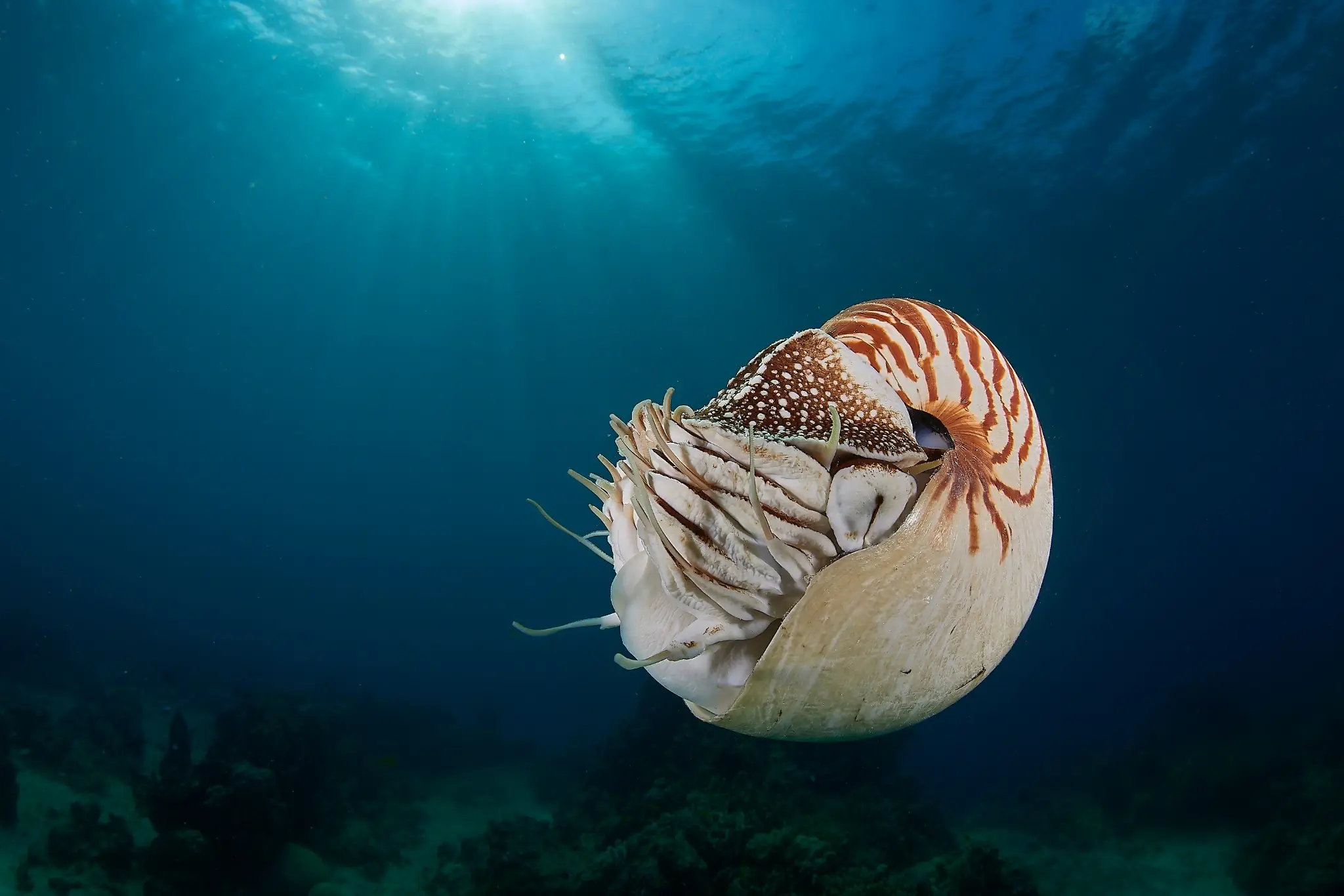
"Every nautilus shell is a diary of its own growth—each sealed chamber a room the animal outgrew and walled away, spiraling backward through its entire life. The living creature occupies only the last and largest room. "
— Reflecting on the chambered shell's growth architecture
The Chambered Shell
Buoyancy by Osmosis
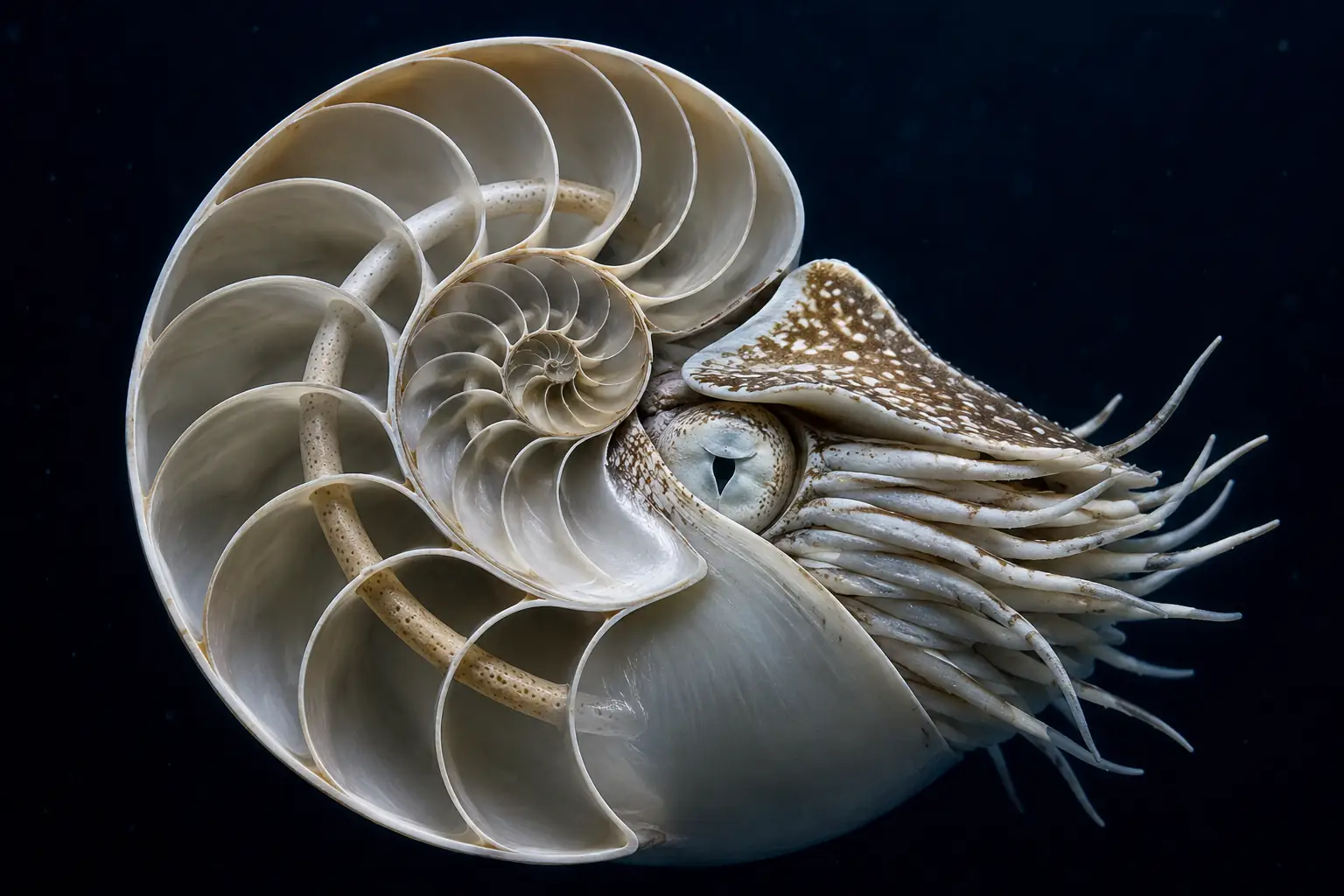
As it grows, the nautilus seals each outgrown chamber behind a wall of shell and shuffles forward into the next. An adult carries roughly 30 compartments holding gas and liquid.
A living tube called the siphuncle threads through them all, pumping salts out to draw the liquid away by osmosis. Gas seeps in behind it, and the animal hangs weightless. Photo: Illustration.
Eyes Without Lenses
Seeing Through a Pinhole
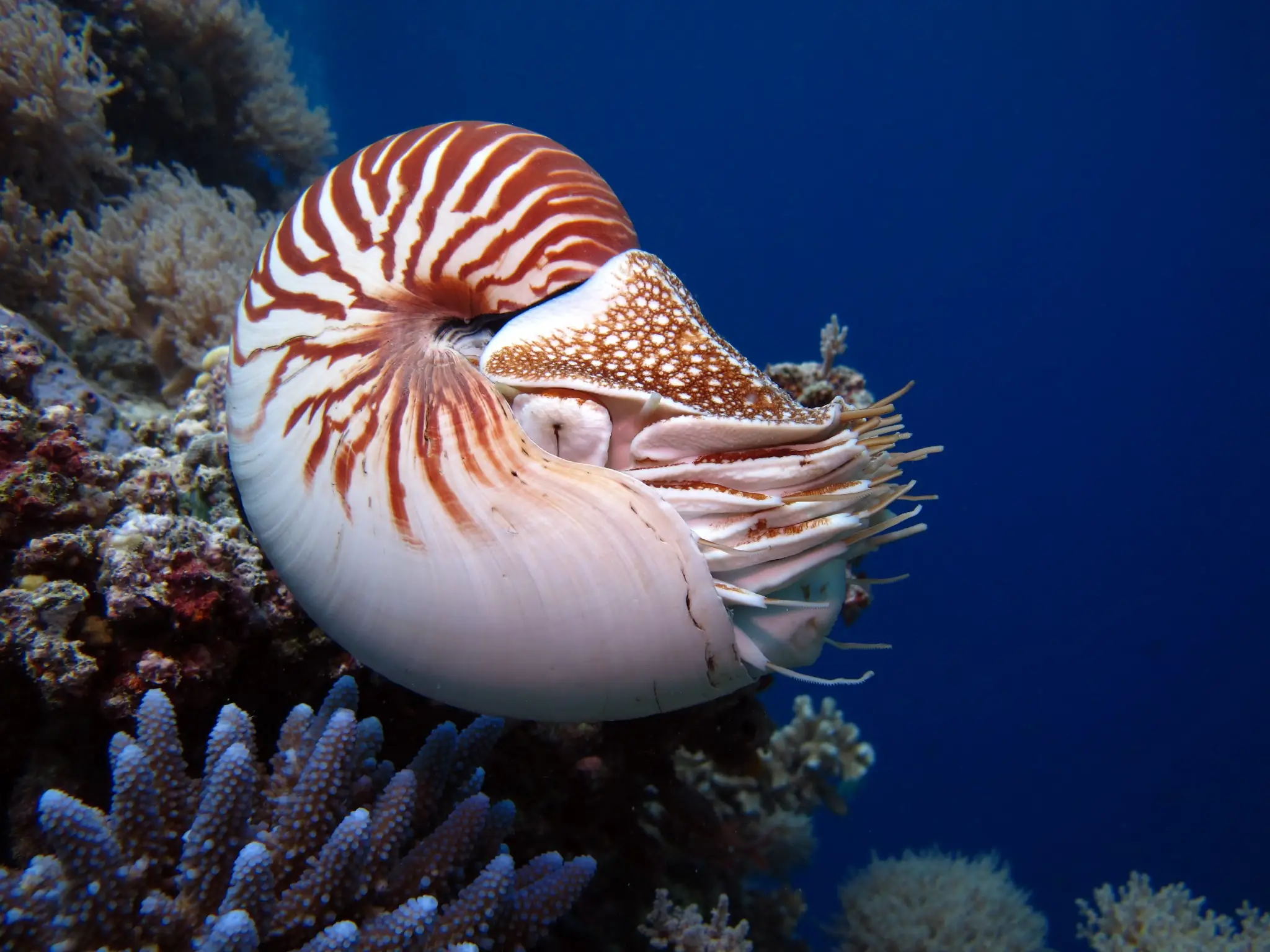
The nautilus eye is a hollow cup of retina open to the sea through a tiny hole. There is no lens, no cornea—just a living pinhole camera filled with seawater.
The image is dim and blurry, so the nautilus hunts mostly by smell instead. Its 2021 genome revealed gene losses and rewired networks that together shaped this simple lens-less eye. Photo: DiveIvanov.
"While ammonites vanished with the dinosaurs and squid traded their shells for speed, the nautilus kept drifting—lens-less, unhurried—through 500 million years of extinctions. An entire dynasty of shelled cephalopods now survives in a handful of species. "
— Grounded in the fossil record of shelled cephalopods
The Scavenger's Crown
Ninety Tentacles and a Beak
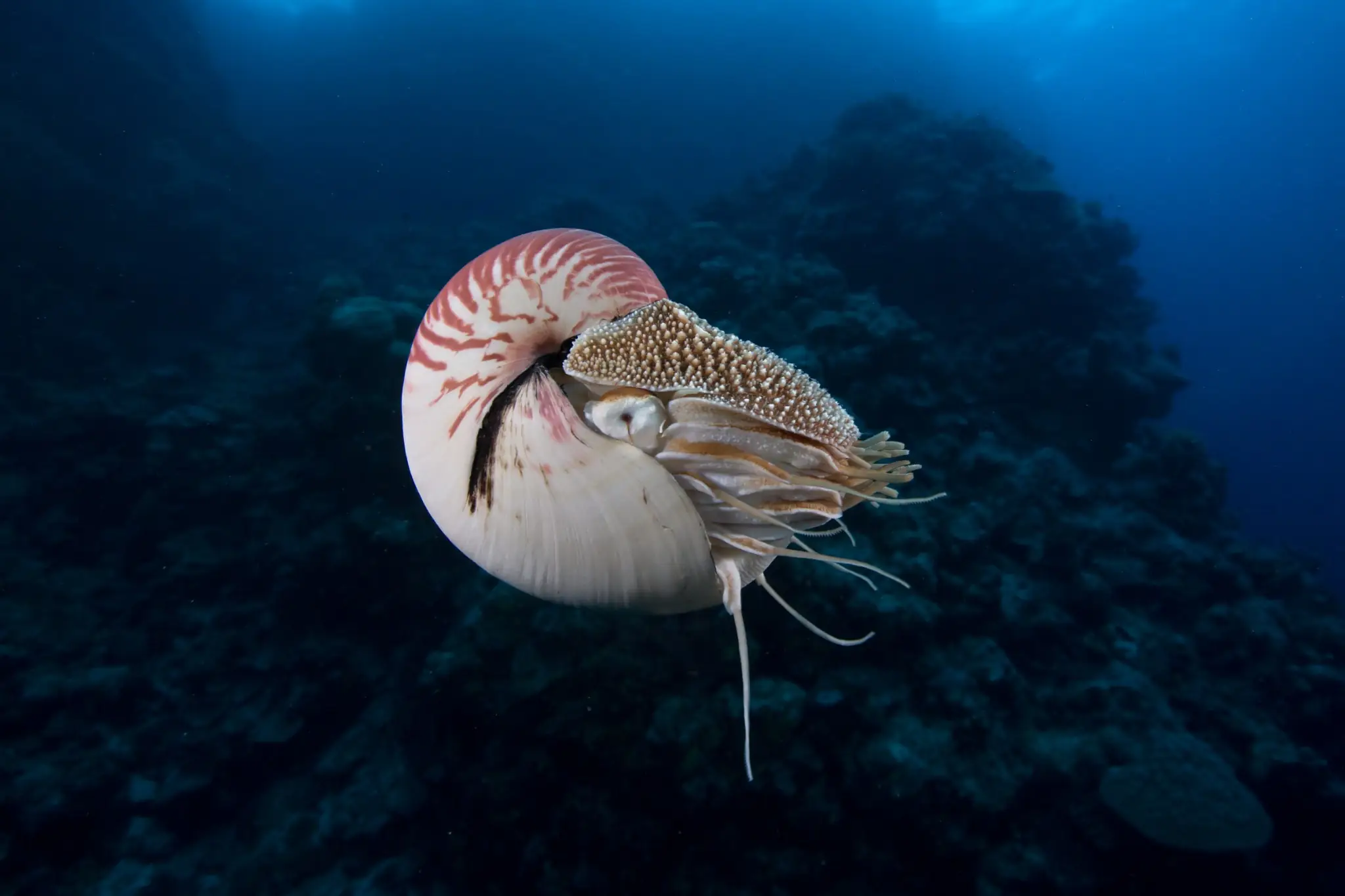
Around 90 tentacles ring the mouth, grooved and sticky but entirely without the suckers of squid. They grip crabs, fish scraps, and molted shells, passing food to a parrot-like beak.
Smell does the hunting. Nautiluses track faint scent plumes across the dark seafloor, locating baited traps within an hour or two, then jetting away on slow rhythmic pulses of water. Photo: Islandjems - Jemma Craig.
A Life in Slow Motion
Fifteen Years to Grow Up
Nothing about the nautilus is fast. It takes roughly 15 years just to reach maturity and can live beyond 20, laying only a dozen or so large eggs each year.
Each egg takes nearly a year to hatch. That slow arithmetic means a heavily fished population cannot bounce back quickly, and captive-bred young have never yet survived to reach adulthood. Photo: imageBROKER.com.
Conservation & Legacy
The Last of a Dynasty
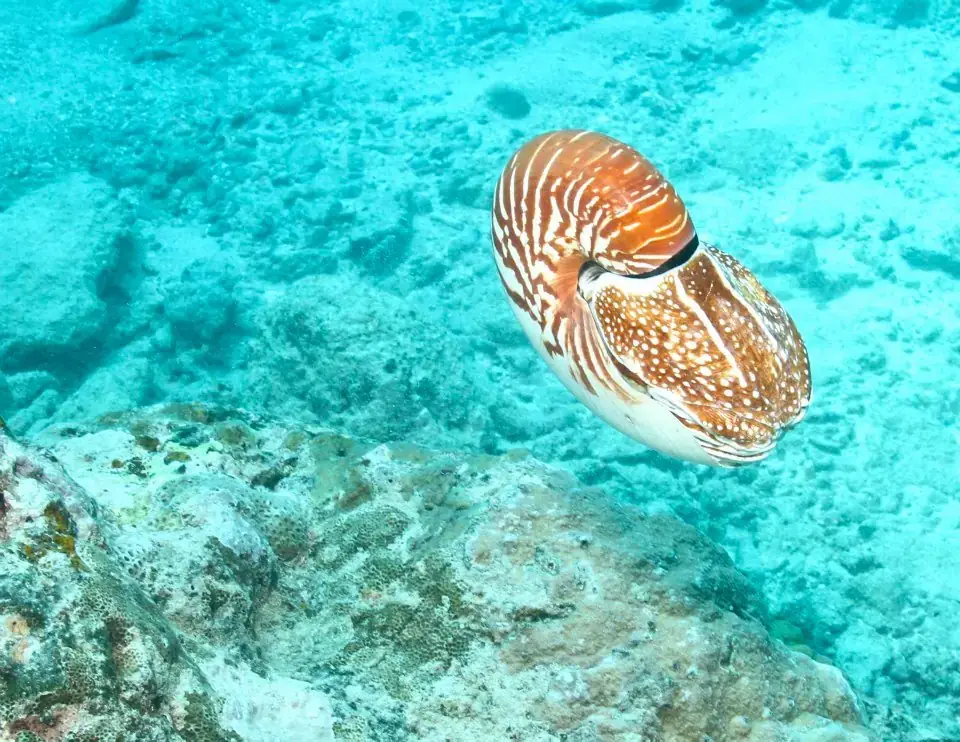
Shell collectors have nearly emptied some reefs. In the Philippines' Tañon Strait one population crashed 97% in just 16 years, and fished sites now hold a fraction of unfished ones.
Since 2016 CITES has regulated the global shell trade, and the United States listed the species as threatened in 2018. Protecting them preserves the very last shelled cephalopods on Earth. Photo: NOAA.
Science & Discovery
The Chinese Academy of Sciences sequenced the nautilus genome in 2021, showing gene losses and rewired networks that shaped its lens-less pinhole eye and its chambered shell.
The City University of New York used baited deep-sea cameras in 2014 to count nautiluses, finding fished Philippine sites held far fewer animals than unfished reefs elsewhere.
The University of Queensland's decade of tagging at Osprey Reef showed in 2011 that nautiluses need about 15 years to mature and can live beyond twenty.
In our delightful oceans, the chambered nautilus survives as the last shelled cephalopod, tuning 30 chambers to hang weightless. Its lens-less pinhole eyes and 15-year climb to maturity leave it fragile. CITES trade limits now guard this 500-million-year lineage.